Professional Cheek (Dimple) Piercing | Contact Our London Experts for Cost & Safety Info
In the world of facial adornment, there are piercings that accent, and then there are those that transform. The cheek piercing—often sought to create the captivating illusion of natural dimples—is a piercing of the latter, more profound category. It is a bold, symmetrical statement that fundamentally alters the landscape of the face, drawing the eye to the smile and creating a look that is at once endearing and unapologetically edgy. It is one of the most impactful and aesthetically powerful facial piercings in existence, a true mark of a piercing connoisseur who is deeply committed to the art of body modification.
However, the allure of this striking look is intrinsically and inseparably bound to a profound and dangerous reality. This is not a standard piercing. It is arguably the most high-risk facial piercing in the entire modern canon. It is an advanced, deep-tissue oral procedure that traverses a complex anatomical landscape, carrying a significant and unavoidable risk of severe and often irreversible complications. Its success is not just a matter of skill; it is a matter of anatomical luck, surgical precision, and a level of healing commitment that is more of a lifestyle than an aftercare routine.
At midnightt, our ethos is built on an unwavering commitment to our clients’ long-term health and well-being. Our reputation as a premier destination for advanced procedures in London is built not only on the beauty of the piercings we create, but more importantly, on the piercings we have the professional integrity and expert knowledge to refuse. This guide is our definitive, honest, and transparent response to the trend of the Cheek (Dimple) Piercing. We believe in radical transparency. We will deconstruct exactly what this piercing is, provide an in-depth, evidence-based explanation of the significant dangers it poses, and explain why we, along with every other top-tier professional studio, approach this procedure with the utmost caution. Our goal is not to disappoint, but to educate and protect, and to ensure that if you do embark on this journey, you do so with your eyes wide open.
Deconstructing the Cheek Piercing: The Illusion and the Dangerous Reality
To understand why this piercing is so exceptionally high-risk, one must first understand what it is, anatomically speaking. Its visual simplicity is a masterful deception that hides a complex and dangerous path.
Cheek (Dimple) Piercing
What is a Cheek (Dimple) Piercing?
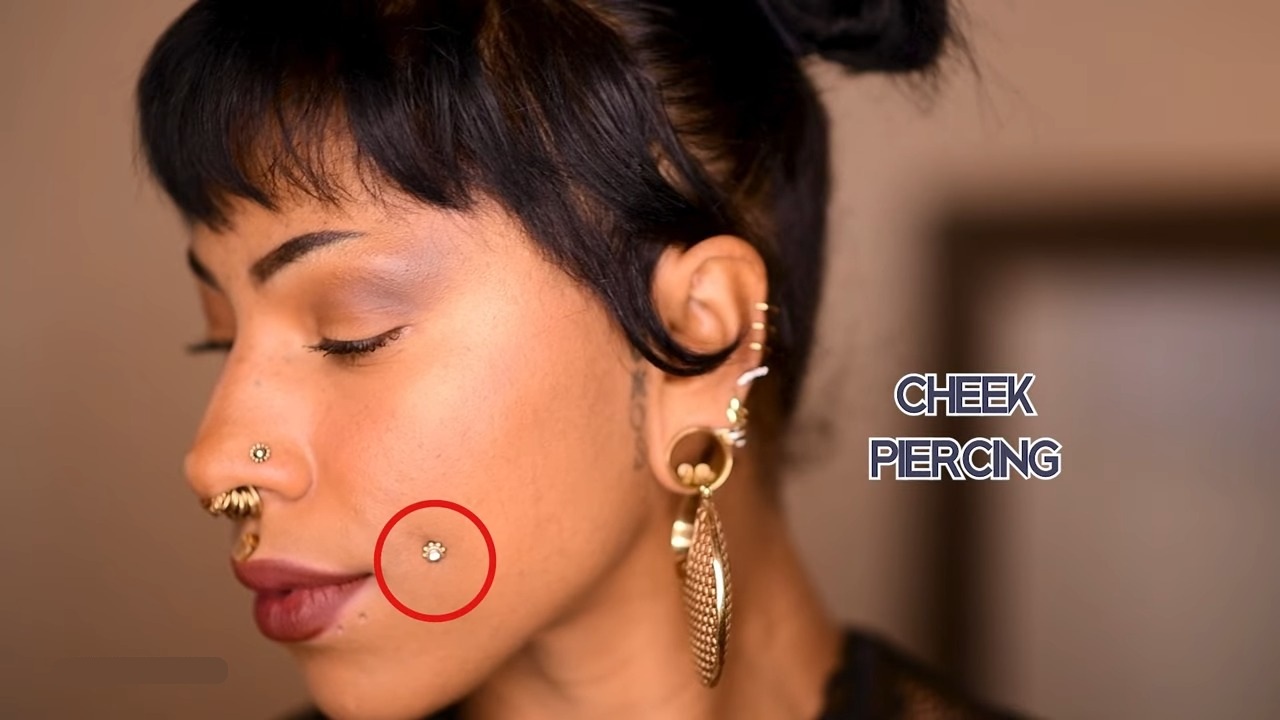
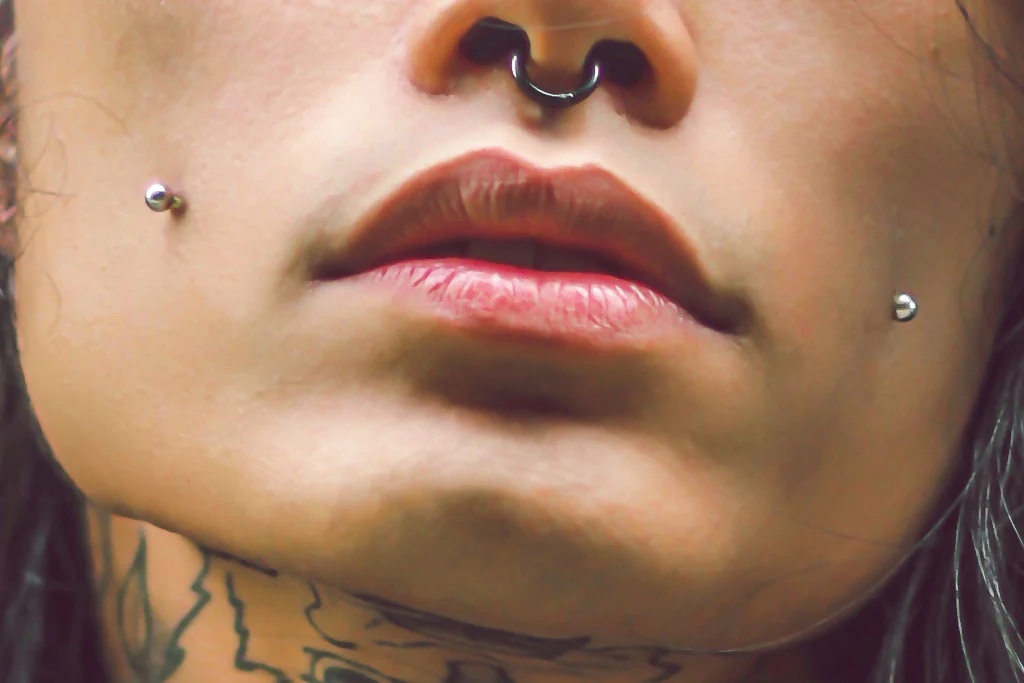
A Cheek (Dimple) Piercing is a piercing that passes directly through the tissue of the cheek, from the outer surface of the skin into the oral cavity.1 It is a true trans-dermal oral piercing, performed with a very long, straight, flat-back labret stud. The decorative end sits on the outside of the cheek, often in the position where a natural dimple would form, while the flat disc rests on the inside, against the inner cheek wall, near the molars. When performed as a pair, they create a symmetrical look that frames the mouth. It is this long channel, passing through a thick and functionally vital area, that is the source of all the severe and unavoidable complications.
The Uncomfortable Truth: The Five Unavoidable Dangers of a Cheek Piercing
The desire for a Cheek (Dimple) Piercing is understandable from a purely aesthetic point of view, but the functional and health risks are so severe that they cannot be ignored. An ethical piercer’s job is to protect their clients from harm, and these are the evidence-based reasons why this piercing is considered fundamentally unsafe for the vast majority of people.
1. The Anatomical Gauntlet: The Risk of Piercing the Parotid Duct
This is the single most significant and functionally catastrophic risk of a cheek piercing. The parotid duct (also known as Stensen’s duct) is a vital part of your anatomy. It is the tube that carries saliva from your largest salivary gland (the parotid gland, located near your ear) into your mouth, entering the inner cheek wall near your upper molars.
- The Danger: The path of a cheek piercing travels directly through the area where this duct is located. An inexperienced or unlucky piercer can easily pierce directly through this duct.
- The Catastrophic Consequence (Salivary Fistula): If the parotid duct is severed by a piercing, it cannot heal itself. This results in a condition called a salivary fistula. Saliva will no longer be correctly routed into your mouth; instead, it will constantly leak out of the piercing hole on your face. This is not a minor leak; it is a constant, uncontrollable stream of saliva running down your cheek. It is a life-altering complication that does not go away on its own and requires complex facial surgery to repair. The risk of this happening, while low in the hands of a master piercer, is never zero.
2. The Marathon Healing Journey: A 1-2 Year Commitment
Even if the parotid duct is successfully avoided, the healing process for a cheek piercing is notoriously long, difficult, and unpleasant.
- The Timeline: You must be prepared for a healing journey of at least 12 to 18 months, and for many, it can take up to two years or longer for the piercings to become truly stable.
- The “Nesting” and Discharge Phase: For the first several months, the piercings will constantly secrete a significant amount of lymph fluid, a clear or whitish fluid that is part of the healing process. This is often mistaken for infection but is a normal, albeit unpleasant, part of the process. You will be constantly cleaning and drying the outside of your face.
- Chronic Flare-ups: Due to the high movement of the area from talking and eating, cheek piercings are prone to random, painful flare-ups of swelling and tenderness for the entire duration of the healing period.

Cheek (Dimple) Piercing
3. The Certainty of Permanent Facial Scarring
This is a non-negotiable reality that every client must accept. A cheek piercing is not like a nostril piercing that leaves a tiny, discreet dot if removed. When you decide you no longer want your cheek piercings, or if they have to be removed due to complications, they will leave permanent, noticeable, indented scars on your cheeks that will look like dimples for the rest of your life. There is no way to avoid this. You must be as comfortable with the idea of having these permanent scars as you are with having the piercings themselves.
4. The High Risk of Dental and Gum Damage
The flat discs of the labret studs on the inside of your mouth are in constant, close proximity to your teeth and gums.
- Tooth Damage: There is a very high risk of accidentally biting down on the flat discs, which can lead to a chipped or cracked molar, requiring expensive dental repair.
- Gum and Cheek Damage: The discs can also rub against your gum line and the soft tissue of your inner cheek, causing chronic irritation and potential recession over the long term.
The Midnightt Protocol: The Anatomy of a Specialist Consultation
Given the extreme risks, the consultation for a Cheek (Dimple) Piercing at our studio is less of a styling session and more of a serious clinical and psychological assessment. Our primary goal is to talk most people out of getting this piercing.
The Non-Negotiable Anatomy Check: Mapping the Danger Zone
This is the first and most critical step. Our specialists are highly trained in oral and facial anatomy. They will spend a significant amount of time, both visually and by gently palpating the tissue inside and outside your mouth, to attempt to map the location of your parotid duct. They will also assess the thickness of your cheek tissue and your bite pattern. If they feel the risk of hitting the duct is too high for your specific anatomy, or that your tissue is too thin, they will refuse to perform the piercing. This is a decision we make with the utmost seriousness.
The Psychological Assessment: Are You Truly Ready?
A piercer’s duty of care for this specific piercing goes beyond the physical. We need to be certain that you have the maturity and commitment to handle the significant challenges.
- Understanding the Healing: We will have a frank and detailed conversation about the long, difficult, and often unpleasant healing process. Are you prepared to deal with months of discharge and flare-ups?
- Accepting the Scars: We will show you photos of the permanent, indented scars that will be left behind. We need to be 100% certain that you understand and accept that these scars are an inevitable part of the journey.
- Commitment to a New Lifestyle: Are you prepared for the multiple, essential downsize appointments? Are you willing to change your diet and oral hygiene habits for months?

Cheek (Dimple) Piercing
The Honest “No”: The Mark of London’s Best Piercing Specialists
After this in-depth consultation, if we have even the slightest doubt about your anatomical suitability, or your understanding of and commitment to the risks, we will refuse to perform the piercing. This is not a judgment. It is the ultimate expression of our professionalism and our unwavering commitment to your lifelong health and well-being. An ethical studio is defined by the piercings they will not do.
| Piercing Aspect | Professional Expectation at midnightt | Dangers of an Inexperienced Piercer |
| Anatomy Check | Meticulous, hands-on assessment to locate the parotid duct. Honest refusal if unsuitable. | No assessment or a cursory glance. A willingness to pierce anyone, regardless of risk. |
| Procedure | Clinical, sterile, inside-out technique to ensure safety. Very long initial bars used. | Outside-in technique, increasing risk. Incorrect jewellery length causing embedding. |
| Aftercare Plan | A detailed plan involving multiple, mandatory downsize appointments. | Vague, generic advice. No mention or plan for downsizing the long initial bars. |
| Long-Term Outcome | A higher (but still not guaranteed) chance of a successful heal in a suitable candidate. | Almost certain complication, from dental damage to a catastrophic salivary fistula. |
Safe and Beautiful Alternatives to the Cheek Piercing
Our refusal to perform a dangerous piercing does not mean we cannot help you achieve a beautiful facial aesthetic. Part of our expert consultation for a Cheek (Dimple) Piercing is guiding you towards safer, more viable, and equally stunning alternatives.
The Premier Alternative: The “Faux Dimple” with Microdermal Implants
This is the most common and effective way to achieve the “dimple” look without the extreme risks of a traditional cheek piercing.
- What They Are: A microdermal is a single-point surface piercing where a small anchor is implanted under the skin, allowing a decorative gem to sit on the surface.7 We can place these symmetrically in the dimple area of the cheeks.
- The Overwhelming Advantages:
- Zero Risk to the Parotid Duct: They are surface implants and do not go anywhere near the vital internal structures of the cheek.
- Zero Risk of Dental Damage: They do not enter the mouth at all.
- Much Easier Healing: While they are still a surface piercing with a risk of rejection, the healing is far more straightforward than a trans-dermal cheek piercing.
- The Honest Caveat: It is crucial to understand that microdermals are also a high-rejection, long-term temporary piercing that will eventually need to be removed and will leave a small scar. However, the risks are significantly lower and the scars far less substantial than with a failed cheek piercing.
Other Creative Placements to Frame the Smile
If you love the idea of piercings that accentuate your smile, we can explore other beautiful and safe options:
- Dahlia Piercings: Two piercings placed at the corners of the mouth.
- Paired Lip Piercings (“Snake Bites”): A classic, symmetrical look that frames the lower lip.
Cheek (Dimple) Piercing
Frequently Asked Questions (FAQ)
1. What actually happens if a piercer hits my parotid duct?
If the duct is severed, it results in a salivary fistula. This means saliva will constantly and uncontrollably leak out of the piercing hole on your face. This condition is permanent and requires complex facial surgery to attempt to repair, which is not always successful.
2. I’ve seen people with healed cheek piercings. Why are you so against them?
You are seeing a tiny handful of “survivors.” For every one successfully healed cheek piercing, there are countless others that have resulted in rejection, severe scarring, and dental damage. The odds are overwhelmingly stacked against a successful outcome. An ethical professional will not take that gamble with your health.
3. Are the scars from a cheek piercing really that bad?
Yes. Because the piercing goes through a thick pad of tissue, when it is removed, the channel heals by collapsing inwards, creating a very noticeable, permanent indentation in your cheek that will look like a dimple for the rest of your life. You must be 100% prepared for this outcome.
4. How much would a specialist cheek piercing consultation cost?
At midnightt, our initial consultations for all piercings, including this one, are complimentary. Our primary goal is to provide you with a full and honest education so you can make an informed decision.
5. What is the piercing procedure itself like, if I am a suitable candidate?
It is an advanced procedure. It is often pierced from the inside of the mouth outwards to give the piercer the best possible control and to avoid the parotid duct. Very long initial barbells are used to accommodate for extreme swelling.9 The pain level is high, and the healing is a very long and difficult commitment.
Conclusion
The Cheek (Dimple) Piercing is an aesthetic of profound commitment and significant risk.10 It is a piercing that should only ever be considered in the hands of a true, master-level specialist with years of experience and a deep, clinical understanding of facial anatomy. At midnightt, our approach is defined by an uncompromising commitment to your lifelong health. Our most valuable service, when it comes to this specific piercing, is often our honest and expert advice to guide you towards a safer, more viable, and equally beautiful alternative.